
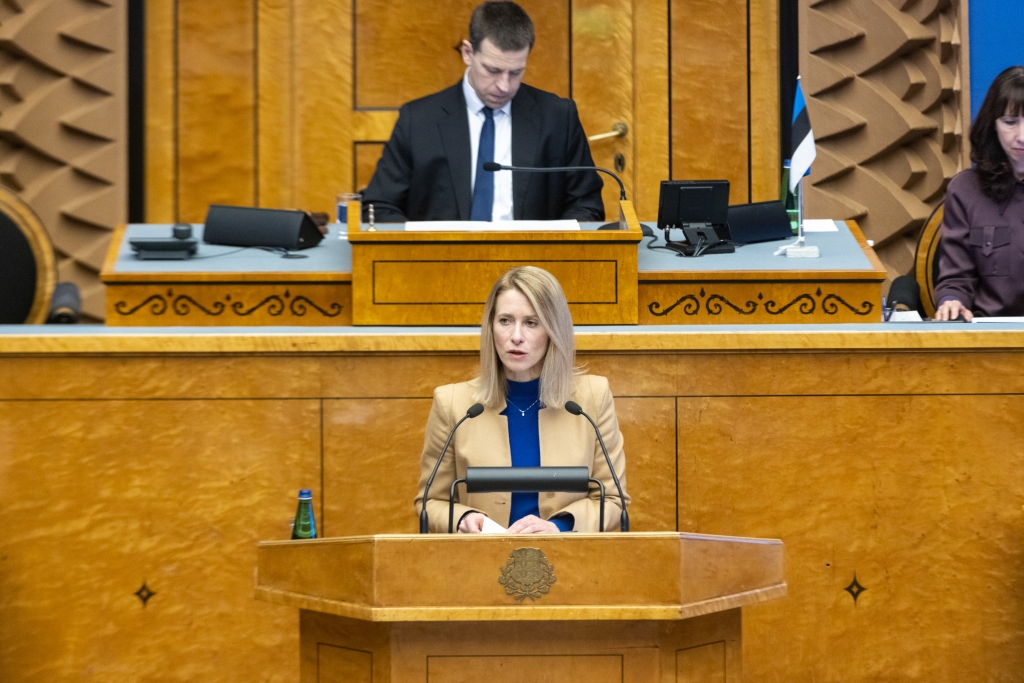
On 24 January, the Government submitted to the Riigikogu the updated National Security Concept of Estonia. This strategic framework document has three main objectives: to describe the security environment at the beginning of 2023, to clarify the goals of Estonia in the increasingly tense security environment, and to describe the steps necessary to achieve the set goals.
I hope that the Riigikogu will approve the National Security Concept before the elections. In the current security environment, this would be an important message to both the people of Estonia and to the international community that all political parties in Estonia are committed to strengthen security.
Let us start with a brief overview of the context of updating our security policy.
We updated the National Security Concept because the international security environment has deteriorated. Russia started a full-scale war against Ukraine. The COVID-19 pandemic that preceded it showed the importance of the effects of a civil crisis. These trends have changed how we think of security policy both in Estonia and in the free world more broadly.
We see a similar process in several countries – as a result of the events of the past year, changes in the security politicy mindset are also formulated in the strategies of our allies and partners.
The renewal of the National Security Concept started in late 2021. Back then, the Government Office organised thematic seminars to where representatives of the Foreign Affairs and National Defence Committees of the Riigikogu, ministries, the private sector, and academic institutions were invited.
The aggression of the Russian Federation against Ukraine called for a new assessment of the security environment. Therefore, we are discussing the updated document in front of the Riigikogu now.
It is important that we can talk about our security directly, in a way that everyone can understand, and focusing on the most pressing issues in the current situation. This is made possible by the National Security Concept with its deliberate brevity, covering the most important topics.
I want to thank the Foreign Affairs and National Defence Committees of the Riigikogu for their contribution to the updating of the security policy and discussing the main principles. As the members of the committees have said, the process was constructive and considerate toward other parties.
This gives us hope as a country that we will find a consensus on important issues such as security and will be able to move forward with the approval of the National Security Concept before the elections.
The updated National Security Concept is based on the key principles of the previous National Security Concept that came into force in 2017. The previous version was long and comprehensive, and a significant part of it is still relevant.
Therefore, the purpose of the updated National Security Concept is not to make fundamental changes or to initiate completely new policies. The updated document describes the changes in the security environment and sets more precise focus for Estonia’s activities.
The objective of Estonia is and has always been to make aggression against the Estonian State impossible. However, we are now doing much more in our capacity and with our allies to ensure our security. We have raised our defence spending to a historically high level. The defence spending of Estonia in 2023 will exceed one billion euros with 2.85 per cent of Estonia’s GDP. In 2022, we allocated an additional 1.2 billion euros to military defence.
The new document points out that the biggest strategic challenge of the current security environment is the intensified confrontation between different political, economic, and social systems. Values based on democracy, market economy, the rule of law, and human rights are under pressure and the ideological counterweight to it is increasing.
We have gone from covert competition to open confrontation, including large-scale hostilities in Europe. Although Tallinn and Kyiv are separated by more than 1,200 kilometres, the aggressor is our common neighbour.
It is existentially important for Estonia that we are part of a democratic community that remains united and strong. The past year has highlighted what we have always known – preserving democracy is also part of security policy. In addition, the war in Ukraine has shown – once again – that working together is the key to our strength.
One of the main changes is that we clearly state that the biggest security threat to Estonia is the Russian Federation. The goal of the Russian Federation is to dismantle and reshape the European security architecture and the rules-based world order and restore the policy of spheres of influence. We have been aware of the threat posed by Russia all along, but it was not usual to talk about it so directly. Russia has long ceased to be a free or democratic country where people can express their opinions without a fear of punishment. According to the recently published Human Freedom Index by Cato Institute, Estonia ranks third in terms of freedom in the world. This is something to be proud of. We are not only the freest country among Eastern European countries – we are also the freest country in both the European Union and NATO. However, this index also reveals an issue. Our neighbour Russia is in the 119th place on the same list, sharing this ranking with Mali. As the Estonian poet Paul Eerik Rummo said – violence loves freedom, it wants to win and conquer it. Russia attacking Ukraine confirms this.
We have always been aware that our neighbour is aggressive and unpredictable.
Now, however, many allies and partners share the same threat assessment. The new Strategic Concept of NATO, which we adopted at the 2022 Madrid summit of NATO leaders, also states this clearly.
Another change compared to 2017 is that China, which is increasing its influence on the international arena and in strategic areas, has been mentioned as a challenge for the first time.
Central to the updated National Security Concept is the recognition that security begins with our own actions. We must do everything in our power to strengthen the security, military defence, and extensive national defence of Estonia.
Although the security policy is in constant development, we can say that Estonia has chosen the right direction in bolstering its security. The strengthening of military defence, the development of extensive national defence, the role of everyone in ensuring crisis resilience, the international activity of Estonia, and strong allied relations continue to be our priorities.
However, due to the changed international security environment, the Estonian state and our society as a whole must make significantly faster and greater efforts to strengthen security and crisis resilience, and be ready for risks which seemed very unlikely before.
Pursuant to the new National Security Concept, in order to strengthen the security of Estonia, the state will focus on five closely related and mutually supportive areas of activity: 1) cohesion of the society and resilience of the state, 2) economic security and vital services, 3) internal security and public order, 4) military defence, and 5) international activities. A chain is only as strong as its weakest link.
In the changed security environment, we need more funding to protect our security interests. The National Security Concept sets a clear ambition in this regard. Due to the growing military threat, it is necessary to increase the level of military defence costs to at least 3% of the GDP, to which the expenses of Estonia as a host country for allies are added.
It is necessary to secure permanent funding for the development of non-military capabilities – extensive national defence as a whole must be strong. By preparing for the most serious crises, including coping during wartime, we will also be ready to resolve situations with a lesser impact.
We have separately highlighted civil protection as one of the priorities, for the effective development of which it is also necessary to ensure permanent funding by the state.
We have to take into account that with the National Security Concept we formulate the direction of development for the people of Estonia and send strategic messages to both our friends and our adversaries. Let us use this opportunity wisely.
I will point out four main messages that the updated National Security Concept carries.
First, Estonia will always defend itself against all threats, regardless of their origin or the time and place of their occurrence, and against any adversary, no matter how big. Estonia will never surrender.
Second, Estonia is not alone. Estonia is part of a community of democratic countries; Estonia is a NATO Ally and a Member State of the European Union. The cornerstones of the Estonian foreign policy activities are our contribution to international organisations, regional cooperation, and close and effective bilateral relations with Allies and partners.
Third, collective deterrence is important. Strong deterrence rests on several pillars:
- NATO must be ready for immediate collective defensive action throughout the territory of the alliance.
- NATO has strengthened its defence stance on the eastern flank of the Alliance based on the principle of deterrence to convince the aggressor that it is impossible to achieve its goals by military means.
- Effective deterrence is a combination of the strengthened defence capability of Estonia, the combat-capable presence of allies integrated with it and designated reinforcement units, a functioning command structure, pre-deployed equipment, high-quality defence plans and regularly organised exercises to practice them, the will of allies, and the ability to quickly transfer additional troops, capabilities, and equipment in the event of a crisis.
And fourth, Estonia is aware of influence activities and is ready to face hybrid threats.
The Russian Federation, among others, consistently uses hybrid attacks to achieve its political goals. Their aim is to impose pressurize on political and social spheres to guide the decisions to a direction suitable for the Russian Federation and create mistrust and the erosions to unity both within countries and in relations between countries.
It is important to realise that a hybrid attack, like a cyber attack, can lead to the invocing of NATO Article 5.
Estonia ensures crisis resilience throughout all areas and it must become part of our daily lives. Continuous cross-sector resilience is essential to make it harder and more costly to attack us and to recover from attacks as quickly as possible. In light of the updated National Security Concept, I would like to point out some of the most important activities in strengthening crisis resilience:
- We ensure secure supply chains and transparency of foreign investments in strategic areas.
- The goal of Estonia is to achieve and maintain complete energy independence from the Russian Federation and to diversify its energy portfolio.
- We ensure a safe cyberspace. Considering the dependence of the Estonian state and society on digital services, the state ensures the availability of public services, as well as the confidentiality and integrity of data, including in crises.
- We ensure the security of Estonia, as well as the European Union and NATO, through effective external border control.
- The continuity of vital services, including during wartime, is essential.
- All levels of society must have reserves for crisis resistance.
- In order to avoid foreign influence over the attitudes of residents and prevent conflicts and threat to the constitutional order, it is necessary to quickly identify and prevent informational influence activities.
- Estonia continues to strengthen the crisis-preparedness of the social and healthcare system based on the current threats and relying on the lessons learned from the COVID pandemic.
The Russian war of aggression against Ukraine began during the updating of the National Security Concept. Many lessons from the war in Ukraine will only become clear over the years, but the current document takes into account its preliminary lessons and the existing knowledge.
First, the aggression against Ukraine showed once again that war is comprehensive – no area in the society is left untouched. Therefore, security needs to be comprehensive. This means that the security of Estonia depends on the contribution of everyone: individuals, communities, private companies, local governments, and constitutional institutions.
Second, we will invest more in the development of both military defence and broad national defence. The contribution of Estonia to strengthening national defence and helping Ukraine is an important signal both internally and externally: we are doing our best to ensure security. In addition, we must always remember that we have to help ourselves first, then others will help us as well.
Third, the will of the people to defend their country at all costs is critical.
Fourth, alliances are central to our security.
Fifth, our voice must be heard on the international stage. International visibility and influence of Estonia has grown. The “never alone again” policy has justified itself – we have a seat at the discussion table and are drivers of joint decisions. Our geography and historical experience mean that our opinion matters. Our knowledge of Russia and understanding of the Kremlin is valued.
People, and especially politicians, often tend to see things not as they are, but as they want to see these things. A typical example and question is whether the war in Ukraine is the war of Putin or the Russian people. I believe that the answer and responsibility in this matter is the same – it is a war of the Russian people and a common crime of the Russian people. As long as the Russian people are unable to change the system, which keeps recreating itself, constantly empowering autocrats who will never give up this position voluntarily or even as a result of elections, the Russian people will also be responsible for the crimes that such absolute power inevitably leads to. In my opinion, this statement makes all kinds of discussions about allowing so-called innocent Russian athletes, cultural figures, and so on and so forth into the international arena completely meaningless. This is also a matter of security, and security cannot be achieved through compromises.
To conclude, strategic frameworks are important to signal political directions and take a national position. The views and choices of the Estonian state and Estonian politicians are noticed far beyond our borders. We are being watched by both our friends and our enemies. This places upon us a responsibility that is greater than ever before. We are heard, we are considered, and we are not alone. We convincingly demonstrate our commitment to security through our actions. This gives us moral justification to expect the same from others.
We must consistently work to ensure the security of Estonia. We still have a lot to do, and updated National Security Concept sets a clear direction for the coming years.
Thank you.

