
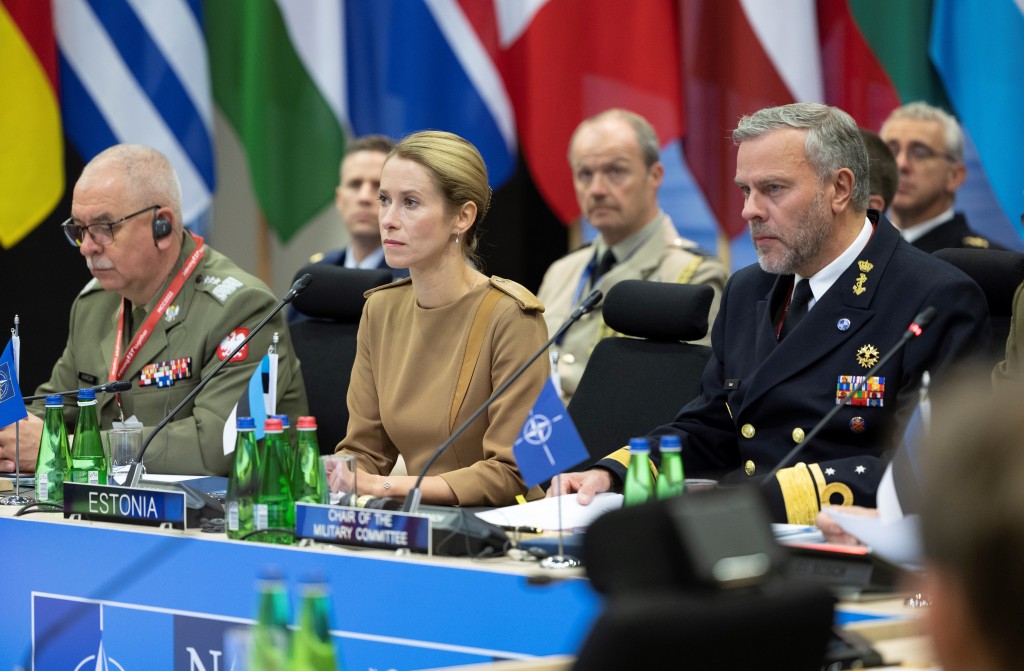
Thank you Mister Chairman,
Your Excellencies,
It is my great pleasure to welcome you here in Tallinn. This means a lot to us and I do not think we have seen so many military leaders here before, or at least I have not.
I particularly welcome the Chiefs of Defence of Finland and Sweden. Tervetuloa, välkommen!
For years, your forces have been training together with NATO forces and participating in crisis management operations. I hope for a swift military integration in the near future. And I do not think it is going to be difficult we just need the political decisions. Your accession to NATO will be an important contribution to the security of the whole Euro-Atlantic area.
I would also like to take a moment to honor the late Queen Elizabeth II whose wisdom and remarkable duty provided stability for 70 years. Her Majesty’s Armed Forces have been leading the enhanced Forward Presence here in Tapa since 2017. We will be forever grateful for the UK’s presence in Estonia.
On the 24th of February, Europe entered a new security reality. Russia’s genocidal war against Ukraine, right on NATO’s doorstep, is the most serious security crisis of our generation.
When it was a surprise to many, it was no surprise to us.
In response, NATO has made a shift in mindset. At the Madrid Summit, Allies defined the Russian Federation as the most significant and direct threat to NATO’s security.
Russia’s aggression is a colossal strategic error as the spirit of Ukrainian population and its military cannot be broken. The recent operational defeat of Russia in the Kharkiv oblast is a sign of Ukrainian grit and astuteness. It shows the effectiveness of Western aid and advice.
The Kremlin’s tactics against the West has a focus to force us to negotiate. The Kremlin uses energy to blackmail us. They have admitted that they want to make Europe “freeze”. They have threatened with global famine. They have threatened with nuclear disasters.
They use the old Soviet negotiation tactics. First, you demand something that has never been yours. Second, you present threats and ultimatums, you terrorize the people and the leaders. Then do not give one inch at negotiations because there will always be people in the West who will offer you something that you did not have before. So, in the end, you will have one third or even a half of something you did not have.
This is why we cannot give in one inch, and we must be prepared to be in it for the long haul.
What we see in Izyum is that under occupied territories even if there is peace the human suffering will continue. This is also the history of Estonia. While there was peace and many closed their eyes and ears what was happening here – the tortures, the sufferings of our people continued. Our people were deported, Russian people were imported.
If we do not counter Russian aggression and expansionism decisively, the whole international rules-based order will be under threat. This means that no country and no nation could feel safe.
If aggression pays off somewhere it serves as an invitation to use it elsewhere. Impunity may encourage other authoritarian leaders. Putin and all of those who have committed war crimes have to know that their judgment day will come.
Legal consequences have to follow. When we have agreed in the international law that it is illegal to occupy, or threaten, or go against another sovereign state, then when somebody does that, there have to be legal consequences for that.
While we are very focused on the conventional war that is going on in Ukraine right now, we must not forget that it is also a hybrid war and an information war going on.
No ally has remained unaffected by intensified hybrid warfare – we have seen an increase of disinformation campaigns and cyberattacks against Estonia and our Allies. These unfriendly activities below the threshold require our daily attention.
The Alliance is not at war. But we are living in a time of war, and we must adapt accordingly.
Putin expects our unity to fall apart over the hard winter. He thinks that the West and the western people are weak. That we cannot survive their threats and we cannot survive the hard winter. We cannot allow this to happen.
Over the last year, I have advocated for a long-term policy of smart containment towards Russia. This means four things.
First, we have been on the right track by directly supporting Ukraine. The ongoing counter-offensive proves that military aid takes Ukraine closer to victory and peace. Our focus must be scaling-up our aid and weapons deliveries to push back the Russian aggression as soon as possible.
Estonia itself has contributed up to 0.8% of our GDP to assisting Ukraine and will continue to provide training to the Ukrainian soldiers for as long as it takes. Ukraine has not won this war until they say that they have won it.
And like we reaffirmed in Madrid, NATO’s door should remain open for European democracies who share the values of the Alliance. If we would not be members of NATO right now, I think Estonia would be living through some very difficult and dark times.
Second, Russia has to be held accountable for their war of aggression, aggression crimes, and war crimes. We need to ensure that the perpetrators will be prosecuted.
Third, we need to raise the cost of aggression. We have witnessed an era of tremendous change – historic support to Ukraine, huge sanctions, increases in defence spending, NATO’s new defence posture.
We must collectively continue to tighten sanctions and isolate Russia internationally.
The EU has adopted the seventh package of sanctions on Russia. However, Russia continues to gain benefits from oil and gas sales. We must remind ourselves that fossil fuel exports are the key enabler of Russia’s warfighting in Ukraine. An army without supplies and low on morale cannot fight for long.
It is also clear that it is not Putin’s war but actually the war of Russian people. The war is hugely supported by the Russian population. Therefore we should use all the tools in the toolbox to actually pressure Russia into ending this war.
That is why we have also advocated for the tourist visa ban. Only 30% of Russian citizens have international passports and they come from the Russia’s elite, this means they also have the possibility to pressure Kremlin into making other decisions if they feel this war effecting their everyday lives.
We must move forward with these significant policy shifts until Russia will change its course.
Fourth, NATO’s new forward defence posture must remain ironclad.
In Madrid the Alliance decided to significantly strengthen its defense and deterrence in the Eastern flank. We have started this work and expect a significant progress to be made before the next Summit in Vilnius.
Adaptation towards forward defence posture for us in Estonia means first of all, that we need to increase our readiness. Since January, we have made significant investments to increase our ammunition stocks, improve existing capabilities and develop new ones, upgrade infrastructure to host allies and also expand training areas. In addition, we are establishing a new divisional structure, which will create better conditions for a possible NATO’s response in our region.
To achieve that, we have raised Estonia’s defense spending up to 2.5% for the next year. And actually only yesterday we made decisions to increase it even further, up to 3% of our GDP.
We also expect to see practical steps taken at NATO to implement the new forward defence posture. This means having executable NATO defence plans in place and exercised. This means a stronger NATO posture in the land, sea and air domains to deny any aggression against its territory.
Estonia fully supports NATO's 360-degree approach. Terrorism is our common concern and we need to jointly address this most direct asymmetric threat to Allied security.
A stable NATO southern neighbourhood is also our immediate security interest. This is demonstrated by the fact that most of our military missions have been to Afghanistan, Africa and the Middle East.
The European Union is our partner and the EU’s efforts in the current situation are complementary to NATO.
NATO also plays an important role in driving innovation. Estonia together with the UK is set to create the DIANA European headquarters. The goal of DIANA, the NATO start-up accelerator is to support technology companies that contribute to defense. It will bring together talented innovators with new technologies end-users in the area of defense.
To conclude, our strength lies in our unity. No only unity among our Allies but also unity within our societies.
It will be vital to keep up our unity in the months to come. No one is thinking that the months to come will be easy. The winter is going to be hard. We have to be prepared for that but we cannot be deterred from our decisions to support Ukraine and end the war.
Over the next two days, you will have a lot to discuss. I wish you successful deliberations at the Military Committee Conference.
Thank you.

