
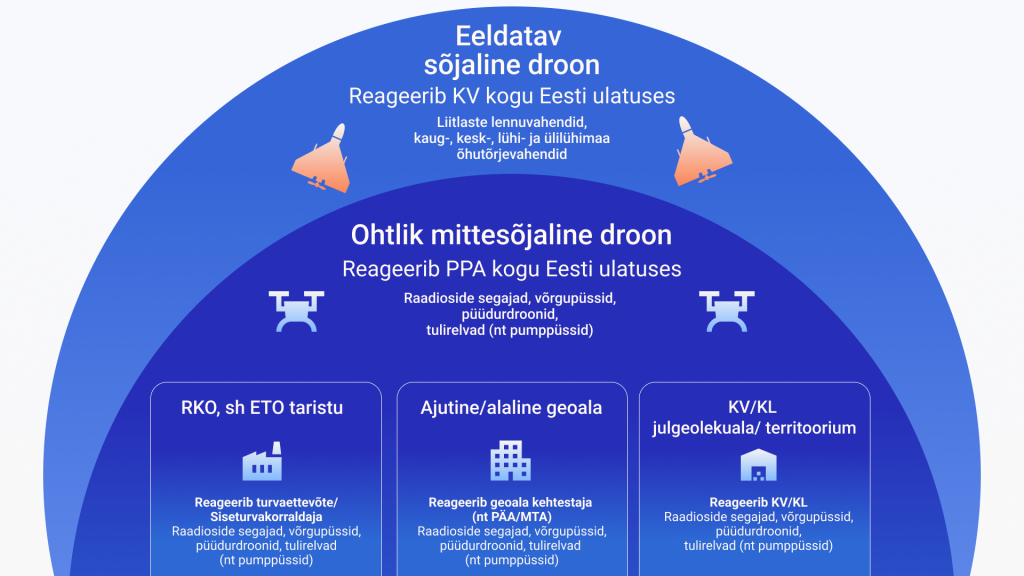
This is an important step towards establishing a multi-layered air defence system, which will expand the capabilities for monitoring and countering unmanned aerial vehicles in peacetime and clarify the responsibilities of different agencies.
According to Prime Minister Kristen Michal, new threats call for new rules. “In a short period of time, drones have significantly altered the nature of aerial threats. It is important to look to the future and establish a legal environment that will enable us to create a multi-layered drone defence system, but also allow Estonian companies to develop innovative solutions for drone defence,” said Michal.
“In the future, drones will play a key role both in the economy and in the provision of public services. Our aim is to make Estonia the most favourable environment in Europe for their implementation. For this purpose, we have drawn up and sent to our partners a drone roadmap which combines the enhancement of national security, the modernisation of public services, and economic growth,” said the Prime Minister.
The draft act, which was approved by the government on Thursday, addresses the most critical shortcomings in the legislation and grants various agencies sufficient powers to detect potential drone threats at an early stage and counter them effectively.
A multi-layered drone defence system will be established, where the Police and Border Guard Board (PPA) will be the first to respond to civilian drones. If the PPA is unable to counter the threat, the Defence Forces will do so. In the case of military drones, the roles are reversed. Security companies responsible for the protection of national defence objects and in-house security organisers are also authorised to intercept drones, both military and civilian drones, and install drone counter-drone systems.
The draft act, which was approved by the government on Thursday, will enable the Defence Forces to better detect and intercept drones used for military purposes, and allow the police to more effectively prevent crime and protect people’s lives and health.
This also creates a uniform monitoring situation. In addition to the Defence Forces and the Police and Border Guard Board, the Transport Administration, the Estonian Air Navigation Services, and possessors of national defence objects also monitor and provide each other with necessary information about objects flying in the airspace.
A so-called ‘drone police’ will be established, and the Police and Border Guard Board will be given the authority, mandate, and resources to intercept dangerous unmanned aerial vehicles, including military drones, throughout Estonia. If the Police and Border Guard Board is unable to counter the threat on its own or do so quickly enough, the Defence
Forces will be authorised to respond; previously, their authority in peacetime was limited solely to responding to threats posed by military drones and drones launched from outside Estonia.
The Defence League will be granted the authority to respond to dangerous drones in order to protect itself and the sites under its guard; furthermore, it will be possible to involve both the Defence Forces and the Defence League in maintaining public order at major events in the event of a drone threat. Security companies and in-house security organisers responsible for the protection of national defence objects will be granted the right to intercept drones at the sites under their guard in the event of an immediate, significant, and heightened threat.
The use of drones, balloons, and other unmanned aerial vehicles has grown rapidly in recent years. Their use has increased particularly in the civilian sector, and Russia’s war of aggression against Ukraine shows that drones are also increasingly being used in criminal activities, espionage, and military attacks. Addressing such challenges requires a clear and transparent distribution of roles, legal accountability, and effective inter-agency cooperation, all of which are significantly improved by the draft act which was submitted to the Riigikogu by the government.
The draft act is merely the first step towards addressing the most critical shortcomings. To facilitate strategic management in this field, the Government Office has drawn up a drone roadmap, which has been sent to public and private sector organisations and partners for feedback. The roadmap currently being drawn up combines increasing national security, modernising public services, and developing the sector, and also brings focus to the next generation of specialists.
Estonia’s ambition is to become the most efficient environment for the development and deployment of unmanned systems in Europe. After analysing the proposals received from the feedback of public and private sector organisations and partners and updating the roadmap, the document is scheduled to be submitted to the government for approval in June this year.
The active implementation phase will begin immediately after approval, and the first reports on the country’s new capabilities and the results achieved will be presented to the public at the end of 2026.

