
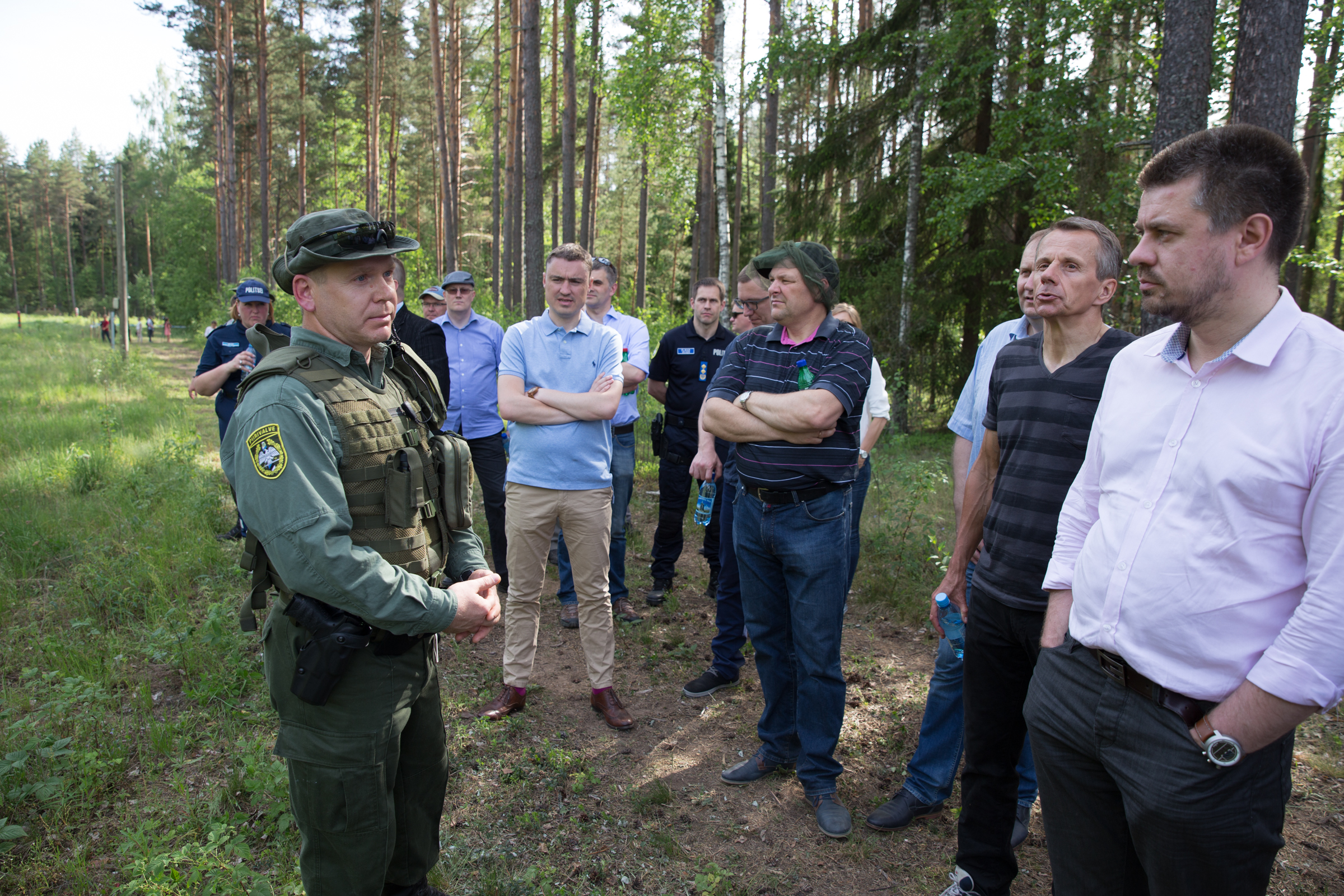
Võmmorski village, 2 June 2016 – The members of the Government visited the south-eastern border together with the Director General of the Police and Border Guard Board and the Head of Piusa Cordon after today’s Government visiting session in order to examine its construction on site. In addition, they visited Koidula railway border crossing and highway border crossing.
“The construction of the eastern border and the development of independent defensive capacity and collective defence form a whole, which aims to ensure that all people living in Estonia can feel secure,” Prime Minister Taavi Rõivas said.
“The Government aims to build out a more modern state border of Europe that would be worthy of the European and NATO external border,” Prime Minister Rõivas said.
A total of 89 percent of the land on the border strip has been cleared out of the 134 km long land boundary.
The ultimate goal of the construction of the eastern border is to fully cover the land boundary with technical surveillance. This enables to immediately identify any activities taking place near the border regardless of the weather, minimise the response time needed to solve any problems, and use the information gathered by the technical surveillance system as evidence in proceeding any offences related to the border.
Photos (the gallery is updated): https://www.dropbox.com/sh/158zpftjh3k9una/AAA7zco9WvTptEFF5E0WCkbva?dl=0
Background:
A modern technical surveillance system will be installed on the border strip.
Depending on the specific nature of the landscape and natural conditions, a boundary fence and a footprint strip that is up to eight metres wide will be installed in places, where the probability of illegal border crossing is higher.
In addition, at least a two-metre wide patrol trail will be established for the border guards.
Animal barrier fences and, if relevant, barriers, border posts, warning signs, and lighting will be installed in necessary spots in order to avoid any false alarms.
The total cost of the high-tech border construction from 2016–2020 is estimated to be about 73 million euros.
In 2016, the Government of the Republic has allocated 20 million euros from its budget to construct the border.
There are 13 cordons (5 cordons and 8 places of service) on the eastern border of Estonia.
The cordons of Narva, Vasknarva, Mustvee, Saatse, and Piusa and the places of service of Narva-Jõesuu, Mustajõe, Punamäe, Alajõe, Varnja, Mehikoorma, Värska, and Luhamaa.
In Narva, service is organised in Narva-1 border crossing point (highway), Narva-2 border crossing point (pedestrian bridge), and Narva railway border crossing point.
Koidula road border crossing point (organises service in the highway border crossing point and Koidula railway border crossing point) and Luhamaa highway border crossing point.
The length of the temporary border line between Estonia and Russia is a total of 338.6 km (the sea border has not been included).
Of which there is a 126.3 km long border on Lake Peipus, a 76.7 km long border on the Narva River, and a 135.6 km long land boundary.
The territorial sea border of Estonia is 122 kilometres.

