
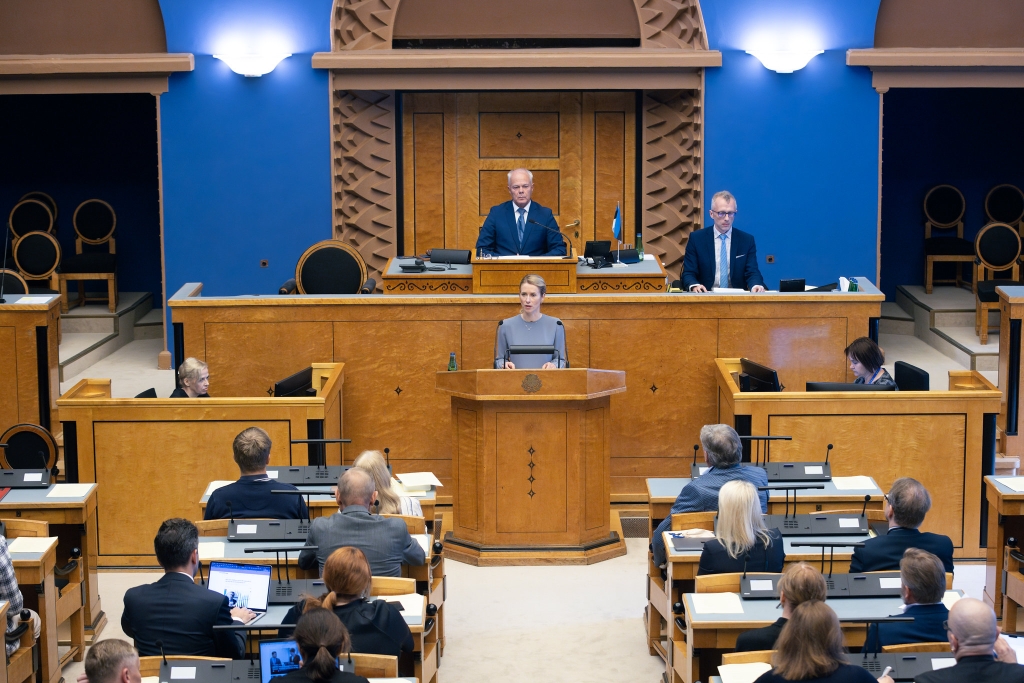
The prime minister stated that although the situation in Europe and in the world is highly complicated, the economic recession continues in Estonia and in its vicinity, and war fatigue is growing in society, we still have reason to feel optimistic, because there are positive signs in the economy.
“Analysts predict that 2024 will be a step towards better subsistence. There is reason to believe that the bottom of the economic recession was reached in 2023 and things will get better in 2024 – the economy is expected to recover. Investments should also return to growth in 2024 after a two-year decline. From 2024, income growth (estimated at 6.6%) will somewhat outpace inflation, which will remain within 4.6%. Despite this, the budget policy of the country must be responsible,” Kallas stressed.
According to Kallas, next year’s budget is best characterised as a step towards ending the spending race. “We have been living beyond our means for the past seven or eight years and, unfortunately, this cannot last forever. The government’s budget policy goal is to improve the state finances step by step, and therefore, the contribution of the government sector to save a total of 350 million in the next four years is very important. We want to bring national debt back under control. A proper budget is an important security guarantee for the Republic of Estonia,” said Kallas. Next year’s nominal budget deficit will be 2.86% of the GDP, or 0.44 percentage points less than this year. With this, Estonia fulfils the requirements of the Maastricht budget criteria.
In austerity conditions, the government will direct significant sums into investments that support the economy and help to implement green reforms. ‘We are channelling 1.9 billion euros in total into the economy as investments and investment subsidies. Investments will be made in, for example, construction and infrastructure development, as well as in agriculture, the implementation of green reforms, and digital development,’ Kallas said. 400 million euros will be allocated to education, 298 million euros to construction, and 117 million euros to investments in the IT field. The green transition is financed from CO2 funds in the amount of 245 million euros.
Among the five most important priorities of next year’s budget are continued investments in national defence and support for Ukraine. ‘Freedom is not a free lunch at the table covered by our allies. And, unfortunately, ensuring security in the vicinity of one of the most aggressive countries in the world is not cheap, either. We must continue to make the funding of national defence a priority, which is why Estonia’s national defence budget exceeds the three per cent limit – it is 3.2% or 1.3 billion euros,’ stated Kallas. She added that she would prefer to spend this money on something else that would improve the lives of Estonians, but this is an existential choice for Estonia. If we do not help Ukraine or protect ourselves, we may be the next target of Russia’s aggressive foreign policy.
In this regard, Kallas noted that the government did everything to ensure that investments in defence and security were as effective as possible. This year is the first time that the government has put together a separate plan for the financing of broad security, which provided an opportunity to compare very different capabilities needed for crises and to determine the most critical needs.
In the funding of broad security, special attention is paid to protecting the population, including threat alert, the organisation of evacuation, crisis preparedness of residents and local governments, as well as disaster medicine. Funds will be allocated to cyber security and countering the spread of misinformation. The prime minister emphasised that good education and the transition to Estonian-language education are part of security.
‘The planned implementation of the action plan for the transition to Estonian-language education will continue in full scale next year. The budget will increase by 27 million euros, and in 2024, 71.9 million euros have been earmarked for the transition to Estonian-language education,’ said Kallas. ‘Motivated teachers have a key role in providing good education, which is why teachers’ salaries will increase despite the very tight budget conditions. Nearly 562 million euros are allocated in the 2024 budget for teachers’ labour costs. In addition, we will support teachers and support specialists who are just starting to work – a total of 3.7 million euros will be allocated as initial support,’ she added.
Finally, the prime minister said that the coalition has decided to stop distributing funds for regional investments (known locally as katuseraha). ‘The nature of this system is non-transparent and not in line with good governance.’
‘The directions agreed upon for the preparation of the 2024 budget allow us to have the courage to look our children in the eye, because we do not wish to leave today’s obligations to our children,’ Kallas expressed hope.
The full text of the political statement of the prime minister regarding the budget: https://www.valitsus.ee/uudised/peaminister-kaja-kallase-poliitiline-avaldus-2024-aasta-riigieelarve-eelnou-uleandmisel
Photos: https://flic.kr/s/aHBqjAWfvq

